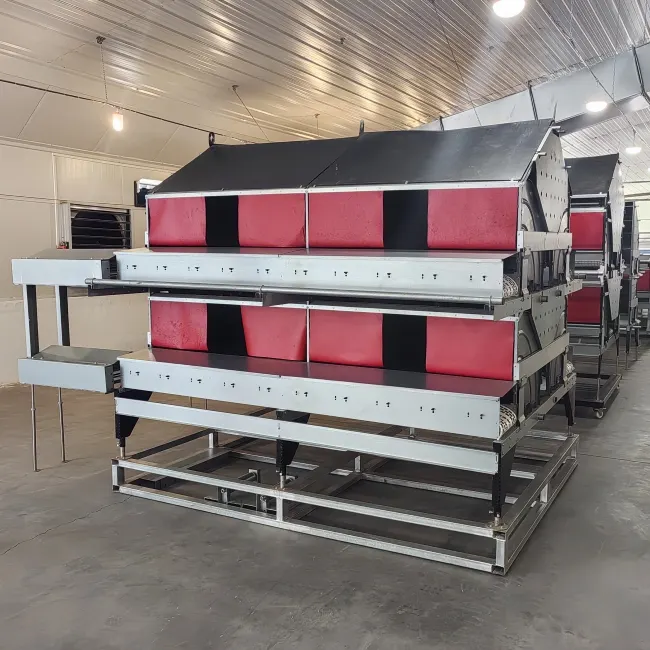
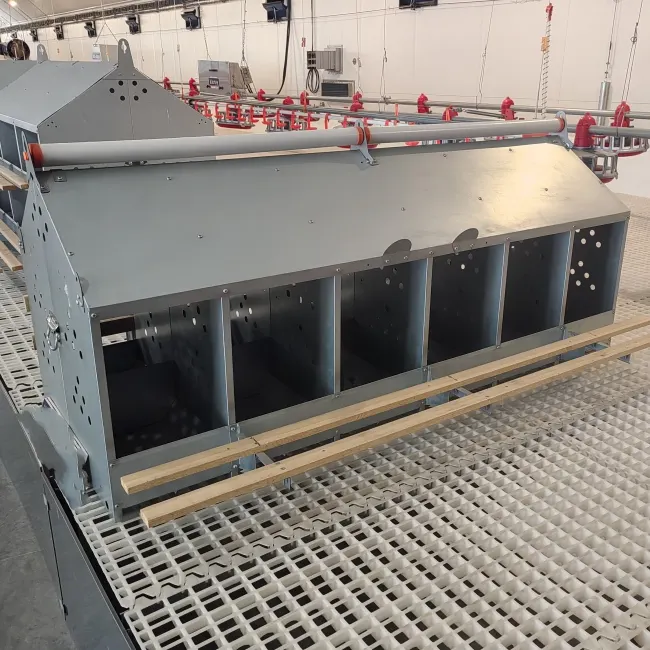
In floor-reared and welfare houses, the difference between a profitable egg floor and a wet, dirty one is nest attractiveness. Our automatic nest box units — double-sided 2300×2200×2240 mm (24 nests) and single-sided 2300×1100×2240 mm (12 nests) — serve 420 and 210 hens respectively, giving each nest the dark curtain, the sloped soft pad and the gentle take-away that hens and labor economics both demand.
Eggs roll off the pad onto a 250 m/min conveyor (1.5 kW) that carries them out of the bird zone within seconds — before a curious hen can peck, before a dropping can land, and before the egg acquires the floor litter that grades it out at the packing station.
Key Features
Timed curtain routine
The dark access curtains give nests the privacy hens seek; opening rhythm trains the flock to lay in the boxes rather than the corners — floor-egg rates are behavioral, and behavior is designed for.
250 m/min take-away belt
A fast, gentle conveyor clears eggs to the pit or room exit, cutting double-clutch pecking and keeping the box cycle clean for the next hen.
Pad options for every market
PVC or wooden laying pads, both sloped for roll-away; PVC washes down fast in hot climates, timber reads warmer on inspection audits.
Modular across the house
Units repeat along a wall or island; feed and water run at the ends, birds find nests in shade, and the layout drawing sequences every unit.
Where Nest Boxes Pay
Floor-egg losses in unmanaged floor houses run 3–8% of production; graded-out eggs sell at a fraction of clean-egg price, so nest-box investment typically returns within one flock cycle on loss reduction alone. The second return is labor — belt collection replaces the nest-checking round, and the house records a stable clean-egg percentage that buyers of hatching eggs (breeder floor operations) will pay a premium to verify.
Ordering
Send flock size and house sketch; we calculate unit count (210 or 420 hens per unit), belt routing to your egg room and the controller program. Units ship galvanized with pads, curtains, belts and drive; assembly videos and drawings included, engineer dispatch optional. The nest line is the standard companion to our floor-rearing and aviary systems and shares the egg-room equipment list with our elevator collection machines.
| Automatic Nest Box System — Specifications |
|---|
| Double-sided unit | 2300×2200×2240 mm · 24 nests · ~420 hens |
| Single-sided unit | 2300×1100×2240 mm · 12 nests · ~210 hens |
| Egg conveyor | 250 m/min, 1.5 kW |
| Laying pads | PVC or wood, sloped roll-away |
| Curtains | Privacy + timed-opening routine |
| Frame | Hot-dip galvanized steel |
| Applications | Floor layers, welfare houses, breeder floor pens |
| Integration | Central egg belts, elevator collectors |
| MOQ | 1 set |
| Warranty | Written terms in proforma |
Shipping, Payment and After-Sales
We export to customers across Africa, Asia and the Middle East — including Nigeria, Tanzania, Ghana, Uganda, Kenya, Zambia, South Africa, Mozambique, Senegal, Cameroon, Zimbabwe, Malawi, the Philippines, Guyana, Gambia and Equatorial Guinea. Full container loads ship as bulk-packed sets; LCL orders travel in wooden cases.
| Payment terms | 30% deposit, 70% balance before loading — T/T, PayPal, Western Union, MoneyGram |
| Lead time | About 600 sets in stock; 5 days to ship from stock, ~20 days after production; full order preparation in ~2 weeks |
| Container loading (typical layer cages) | 20GP: 130 sets (3-tier) / 100 sets (4-tier) · 40GP: 280 / 210 · 40HC: 300 / 225 |
| Sea transit (reference) | Lagos ~45 d · Mombasa 25–43 d · Tema ~50 d · Cebu/Manila 12–14 d · Durban ~30 d · Maputo ~36 d · Dar es Salaam ~38 d |
| After-sales | Installation drawings and videos free of charge, online guidance, engineer dispatch available, lifelong poultry-farming consultant support |
Why Buyers Choose ZEUSYANG
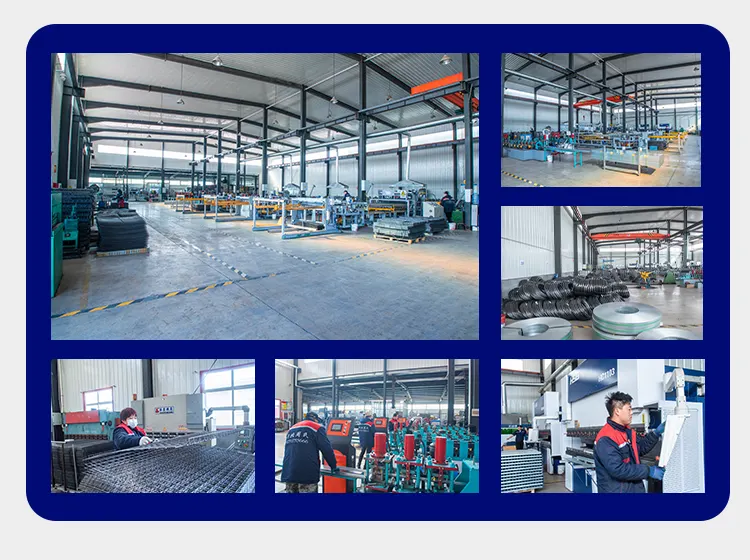
- Own factory, 15+ years — hot-dip galvanizing, roll-forming and welding lines under one roof in Cangzhou, Hebei. Video factory tours available on request.
- One-stop supply — cages plus feeding, drinking, egg collection, manure removal, ventilation, cooling and environmental control from a single quotation.
- Engineered for longevity — 275 g/m² hot-dip galvanized surfaces rated 15–20 years in house; stainless and aluminum wear parts where corrosion is worst.
- Layout before quotation — send flock size and house dimensions, our engineers return cage layout drawings, equipment lists and FOB prices.
- Delivery you can plan around — about 600 sets in stock, 2 weeks to prepare a full order, 5 days to ship from stock or 20 days after production.
- Installation that works at destination — free drawings and installation videos, online guidance, and engineer dispatch to your farm when needed.