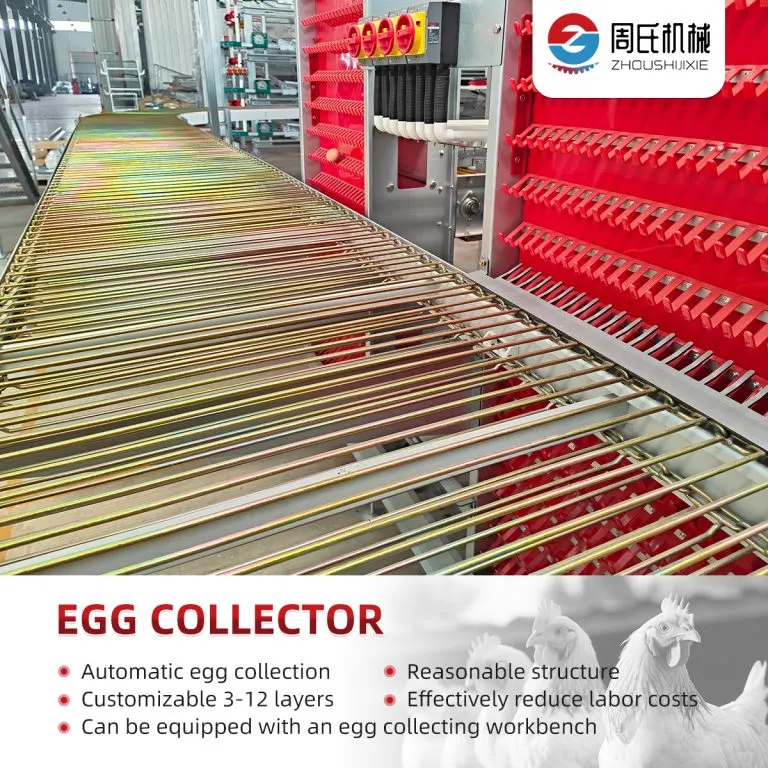
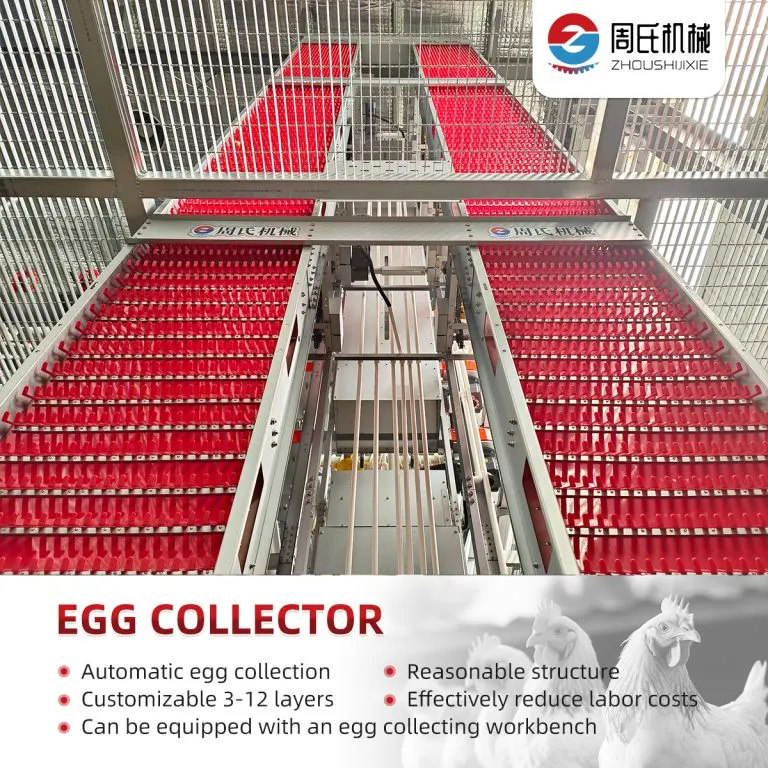
Hand-collecting eggs from a 60,000-bird house is a six-hour job performed badly twice a day. Our elevator-type automatic egg collection system moves eggs from every tier of cage face, across the pit, up the elevator and into the egg room at a controlled 6.5 m per minute — a speed chosen because faster belts break shells and slower ones cannot clear a peak-lay house. A single line tops out at 65,000 eggs per hour; each row's elevator handles up to 19,000 per hour against a typical 10,000–12,000 requirement, which is the headroom that keeps a house moving on peak-lay Saturdays.
Construction is built for the corrosive reality of a layer house: aluminum-alloy side frames, manganese-steel galvanized conveyance chains at 750 mm pitch, self-lubricating wear-resistant plastic guides, and a 0.37 kW 380 V geared drive (i = 80.65:1, customizable voltage) that will run 20 cycles a day for years.
Key Features
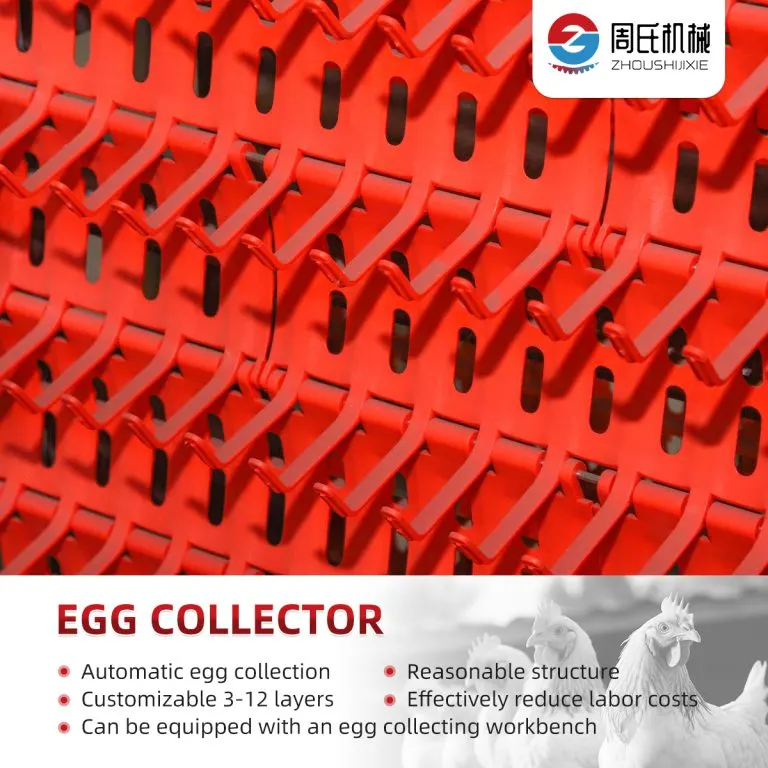
Egg-safe transfer engineering
Roller egg faces, gentle elevator angle and brush strips control every transfer — breakage and hairline cracks (the silent grading loss) are what this machine is actually engineered against.
Soft-egg filter and collection drawer
A soft/shell fragment filter with a pull drawer removes the problem before it jams the line or contaminates the case-eggs downstream.
0–20° adjustable ramp geometry
Pit-crossing and lift ramps adjust 0–20° on site, so the same line suits 3-tier small houses and 12-tier industrial plants without re-engineering.
Runs to your power reality
380 V standard with 220 V / single-phase / other-frequency drives built to order — Nigerian 336 V or Philippine 60 Hz houses are routine variants.
Sizing an Egg Line Properly
The sizing rule: hourly peak = (hen count × lay rate) ÷ collection cycles, with elevator rows cross-checked against the 19,000/h row limit. A 60,000-hen house at 90% lay collecting 6 times per day peaks near 9,000/h per collection window — comfortably inside one line's envelope with a safety margin for double-ovulation season and peak weeks. We size belt runs, elevator drops and egg-room exit heights on the layout drawing before you ship, which is the stage where the alternative (retrofitting) becomes expensive.
Integration With the Whole House
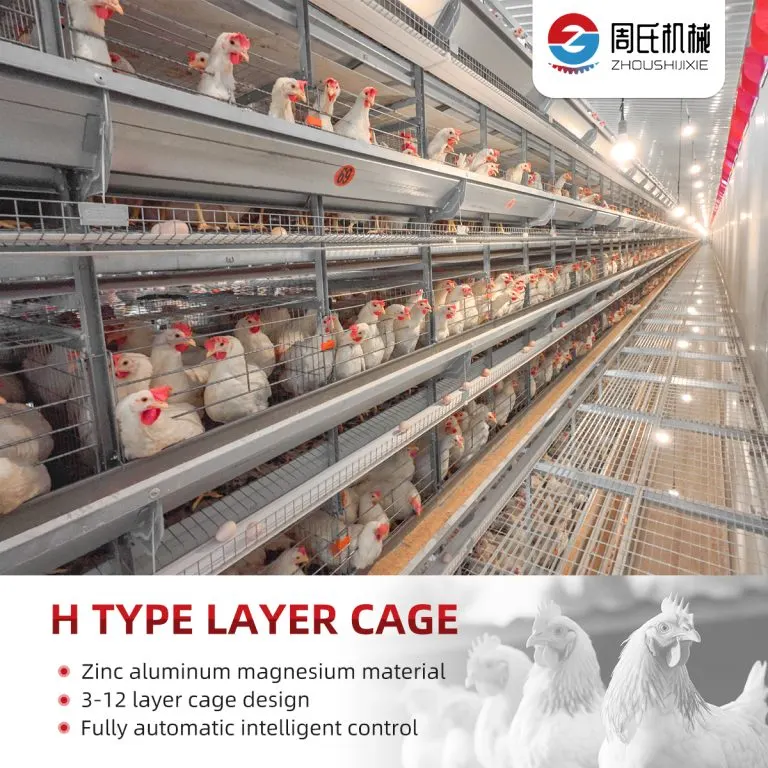
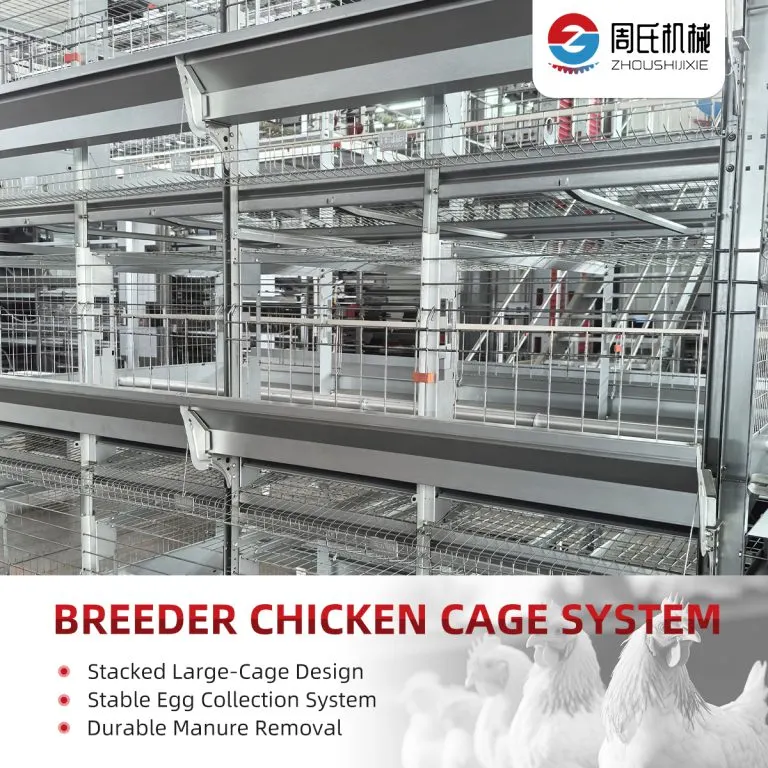
The system couples directly to our H-type and small-stack layer faces (55 cm collection face), chain-linked to central collection, and can feed an egg grading room or cold storage on the same drawing. Central systems, egg grading machines and setting-box washers are supplied from the same catalog — one control philosophy, one spare-chains shelf. The unit ships flat-packed with mounting rails; installation videos and drawings are free, and a single set MOQ means even a two-house farm automates collection first and buys the grading table next quarter.
| Automatic Egg Collection System — Specifications |
|---|
| Belt speed | 6.5 m/min (egg-safe envelope) |
| Max capacity | 65,000 eggs/h system-wide |
| Per-row elevator | up to 19,000 eggs/h (typical need 10,000–12,000) |
| Drive | 0.37 kW, 380 V, i = 80.65:1 — voltage customizable |
| Chain | Manganese steel, galvanized, 750 mm pitch |
| Frame | Aluminum alloy; self-lubricating plastic guides |
| Ramp angle | 0–20° adjustable |
| Tier compatibility | 3–12 tiers |
| Extras | Soft-egg filter + drawer · egg-brush strips |
| MOQ | 1 set |
Shipping, Payment and After-Sales
We export to customers across Africa, Asia and the Middle East — including Nigeria, Tanzania, Ghana, Uganda, Kenya, Zambia, South Africa, Mozambique, Senegal, Cameroon, Zimbabwe, Malawi, the Philippines, Guyana, Gambia and Equatorial Guinea. Full container loads ship as bulk-packed sets; LCL orders travel in wooden cases.
| Payment terms | 30% deposit, 70% balance before loading — T/T, PayPal, Western Union, MoneyGram |
| Lead time | About 600 sets in stock; 5 days to ship from stock, ~20 days after production; full order preparation in ~2 weeks |
| Container loading (typical layer cages) | 20GP: 130 sets (3-tier) / 100 sets (4-tier) · 40GP: 280 / 210 · 40HC: 300 / 225 |
| Sea transit (reference) | Lagos ~45 d · Mombasa 25–43 d · Tema ~50 d · Cebu/Manila 12–14 d · Durban ~30 d · Maputo ~36 d · Dar es Salaam ~38 d |
| After-sales | Installation drawings and videos free of charge, online guidance, engineer dispatch available, lifelong poultry-farming consultant support |
Why Buyers Choose ZEUSYANG
- Own factory, 15+ years — hot-dip galvanizing, roll-forming and welding lines under one roof in Cangzhou, Hebei. Video factory tours available on request.
- One-stop supply — cages plus feeding, drinking, egg collection, manure removal, ventilation, cooling and environmental control from a single quotation.
- Engineered for longevity — 275 g/m² hot-dip galvanized surfaces rated 15–20 years in house; stainless and aluminum wear parts where corrosion is worst.
- Layout before quotation — send flock size and house dimensions, our engineers return cage layout drawings, equipment lists and FOB prices.
- Delivery you can plan around — about 600 sets in stock, 2 weeks to prepare a full order, 5 days to ship from stock or 20 days after production.
- Installation that works at destination — free drawings and installation videos, online guidance, and engineer dispatch to your farm when needed.