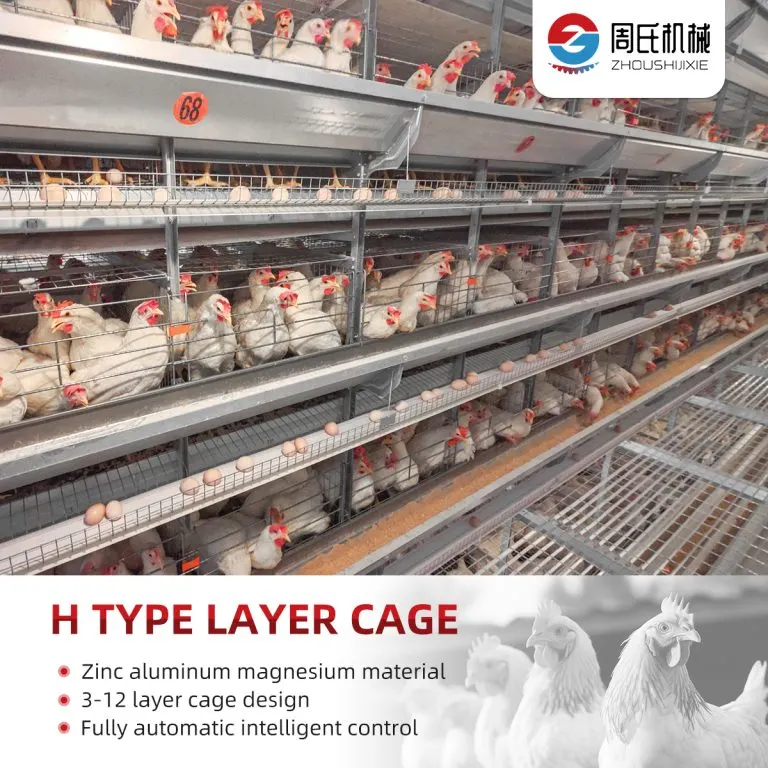
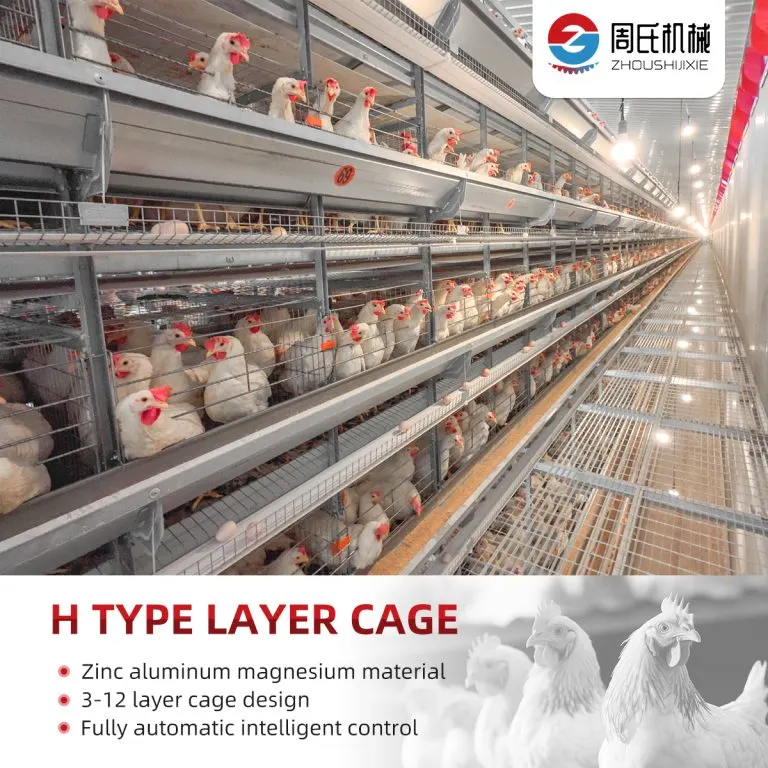
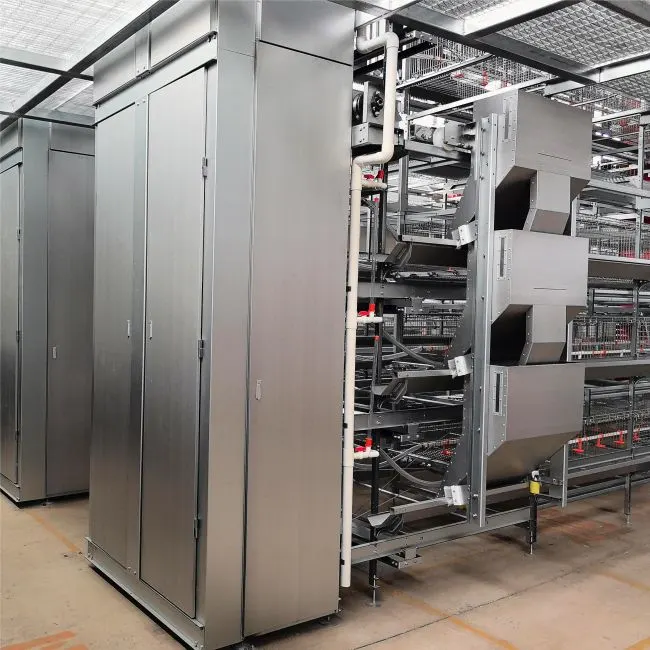
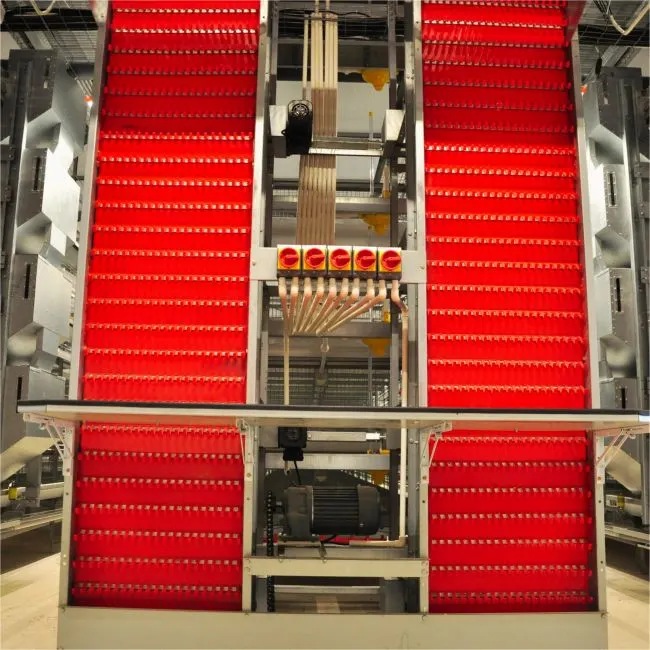
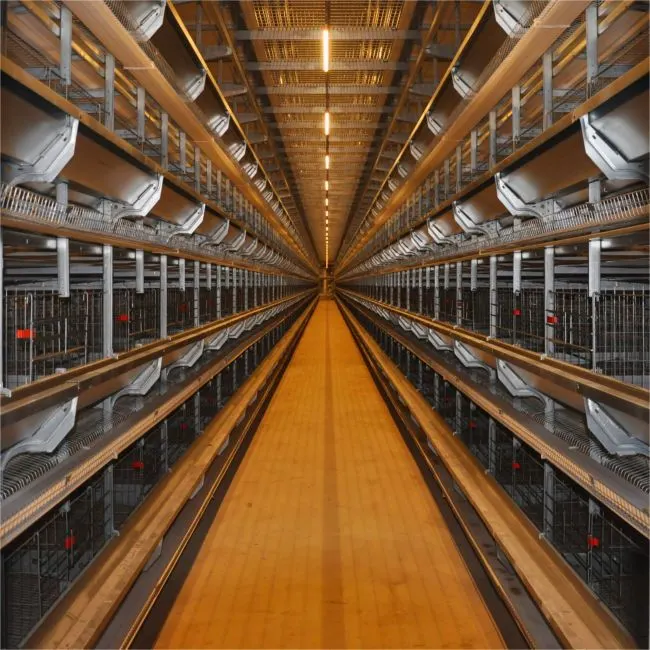
Manure left under birds does three expensive things: generates ammonia that suppresses feed intake and burns respiratory tissue, releases moisture that wets litter and grows pathogens, and harbors darkling beetle and fly populations that then infest the whole farm. Our automatic manure removal systems solve all three the same way — the droppings never stay in the bird zone. On multi-tier cage houses each tier carries its own PP manure belt running to a pit or outside cross-conveyor; on single-tier and floor houses, scraper or pit-belt arrangements do the same duty.
Because belts run under every tier on our H-type and small-stack systems, the manure that reaches the belt is already separated from birds, feed and eggs — a single daily pass moves it out of the house entirely, and on layer plants that daily rhythm is what keeps winter ammonia readings near zero with minimal ventilation penalty.
Key Features
One belt per tier
Stacked houses fail on manure when one belt serves several tiers — ours runs beneath every tier, so a stuck belt is a detected fault, not a two-story manure collapse.
PP belts with anti-corrosion hardware
Acid manure eats steel edges; our polypropylene belts with galvanized drum and roller sets stay straight and do not pit-wear through on seams.
Daily extraction discipline at machine speed
Drum-driven with take-up tension, end clean-off blades and limit protection; a timer on the environmental controller runs the daily pass without a decision being made by a tired worker.
Dry, sellable manure
Manure out daily in a closed pit or belt line dries to a handleable, salable product — on many of our layer projects the manure revenue quietly pays the belt system's cost within a flock.
The Ammonia Arithmetic
Ammonia above 20–25 ppm depresses feed intake and egg shell quality; stacks and poorly-served pits blow past that daily in warm weather without removing it is a ventilation decision you pay for in feed. Daily belt removal cuts the generation source instead, letting you run smaller winter ventilation (less fuel, less draft stress) while readings stay clean. In welfare and audit programs, belt-removed manure is also the difference between passing litter-condition checks and writing action plans.
Engineering It Into Your House
Belts ship cut to your row lengths with drums, tensioners, drives, end transitions and outside cross-conveyors or pit augers to the collection point. Tiers, house length and manure destination (drying shed, tanker, bagging) fix the power and control spec on the drawing; drives run on our standard 380 V/220 V options as always. Belts, scrapers and drive chains are stocked consumables shared across our cage platform — order a spare set with the commissioning kit and the farm never walks a belt at peak lay.
| Automatic Manure Removal System — Specifications |
|---|
| Type | Per-tier PP belt (cage houses) · scraper/pit belt (floor & single-tier) |
| Belt | UV-stabilized PP, welded loop, end clean-off |
| Drive | Geared drum with take-up tension + limit switches |
| Removal rhythm | 1–2 passes/day on controller timer |
| Manure routing | Pit belt / cross conveyor / auger to drying or collection |
| Ammonia effect | Major reduction at source vs stored-manure houses |
| Voltage | 380 V standard · 220 V / other on request |
| Compatibility | All ZEUSYANG cage systems; retrofit on request |
| MOQ | 1 set |
| Warranty | Written terms in proforma |
Shipping, Payment and After-Sales
We export to customers across Africa, Asia and the Middle East — including Nigeria, Tanzania, Ghana, Uganda, Kenya, Zambia, South Africa, Mozambique, Senegal, Cameroon, Zimbabwe, Malawi, the Philippines, Guyana, Gambia and Equatorial Guinea. Full container loads ship as bulk-packed sets; LCL orders travel in wooden cases.
| Payment terms | 30% deposit, 70% balance before loading — T/T, PayPal, Western Union, MoneyGram |
| Lead time | About 600 sets in stock; 5 days to ship from stock, ~20 days after production; full order preparation in ~2 weeks |
| Container loading (typical layer cages) | 20GP: 130 sets (3-tier) / 100 sets (4-tier) · 40GP: 280 / 210 · 40HC: 300 / 225 |
| Sea transit (reference) | Lagos ~45 d · Mombasa 25–43 d · Tema ~50 d · Cebu/Manila 12–14 d · Durban ~30 d · Maputo ~36 d · Dar es Salaam ~38 d |
| After-sales | Installation drawings and videos free of charge, online guidance, engineer dispatch available, lifelong poultry-farming consultant support |
Why Buyers Choose ZEUSYANG
- Own factory, 15+ years — hot-dip galvanizing, roll-forming and welding lines under one roof in Cangzhou, Hebei. Video factory tours available on request.
- One-stop supply — cages plus feeding, drinking, egg collection, manure removal, ventilation, cooling and environmental control from a single quotation.
- Engineered for longevity — 275 g/m² hot-dip galvanized surfaces rated 15–20 years in house; stainless and aluminum wear parts where corrosion is worst.
- Layout before quotation — send flock size and house dimensions, our engineers return cage layout drawings, equipment lists and FOB prices.
- Delivery you can plan around — about 600 sets in stock, 2 weeks to prepare a full order, 5 days to ship from stock or 20 days after production.
- Installation that works at destination — free drawings and installation videos, online guidance, and engineer dispatch to your farm when needed.