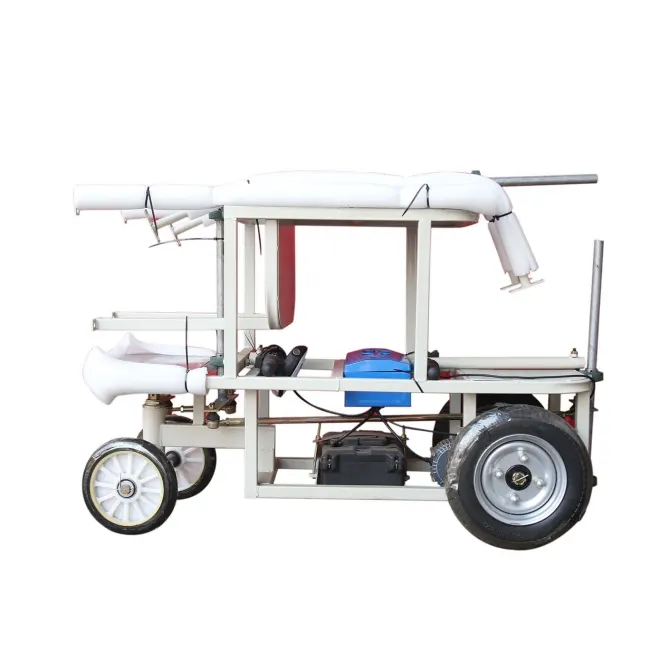
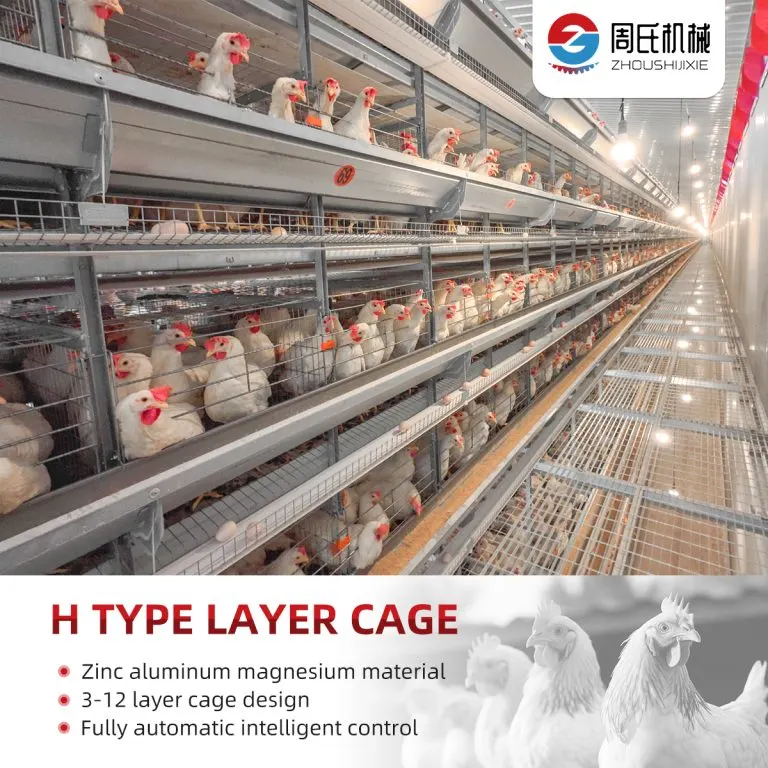
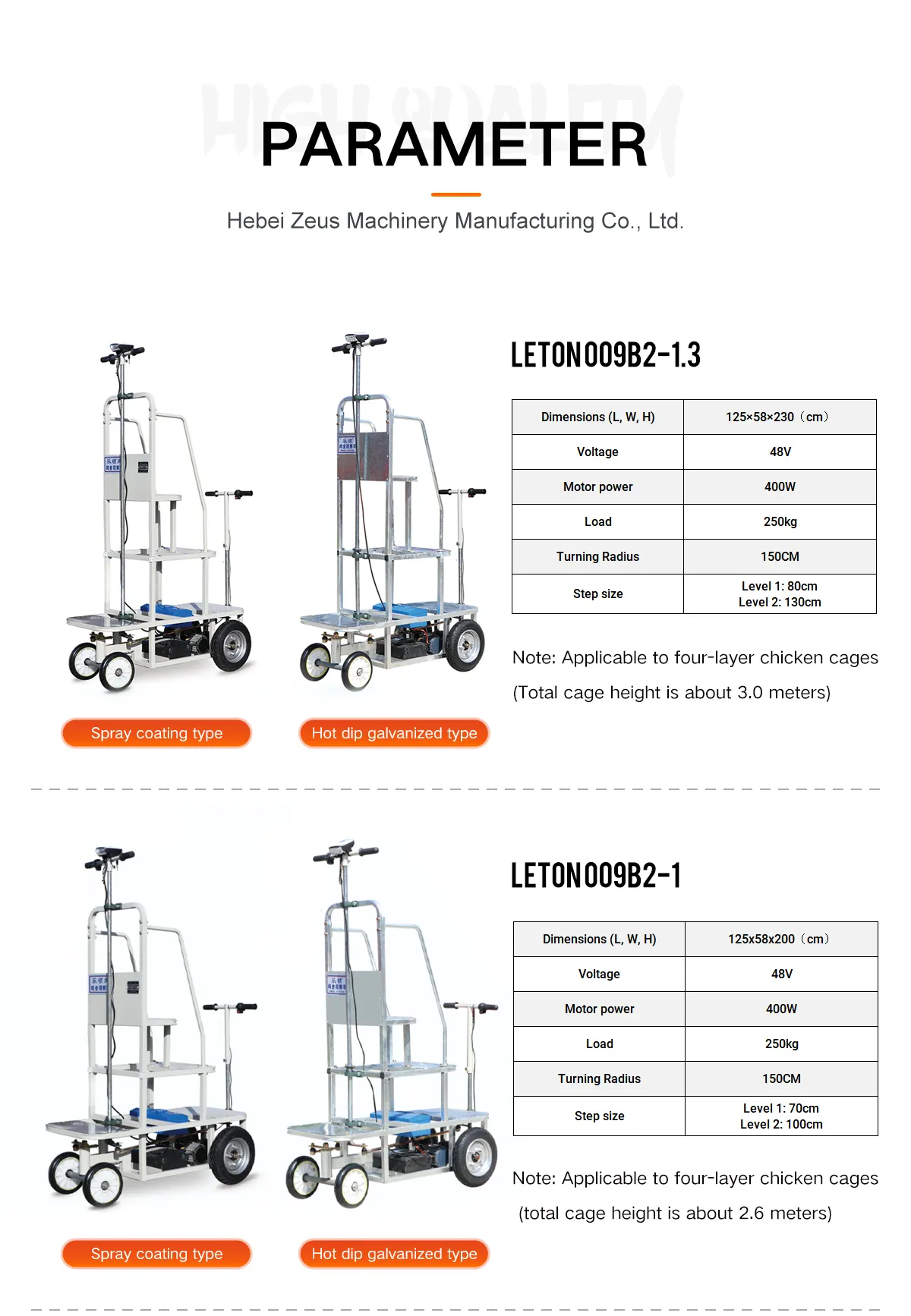
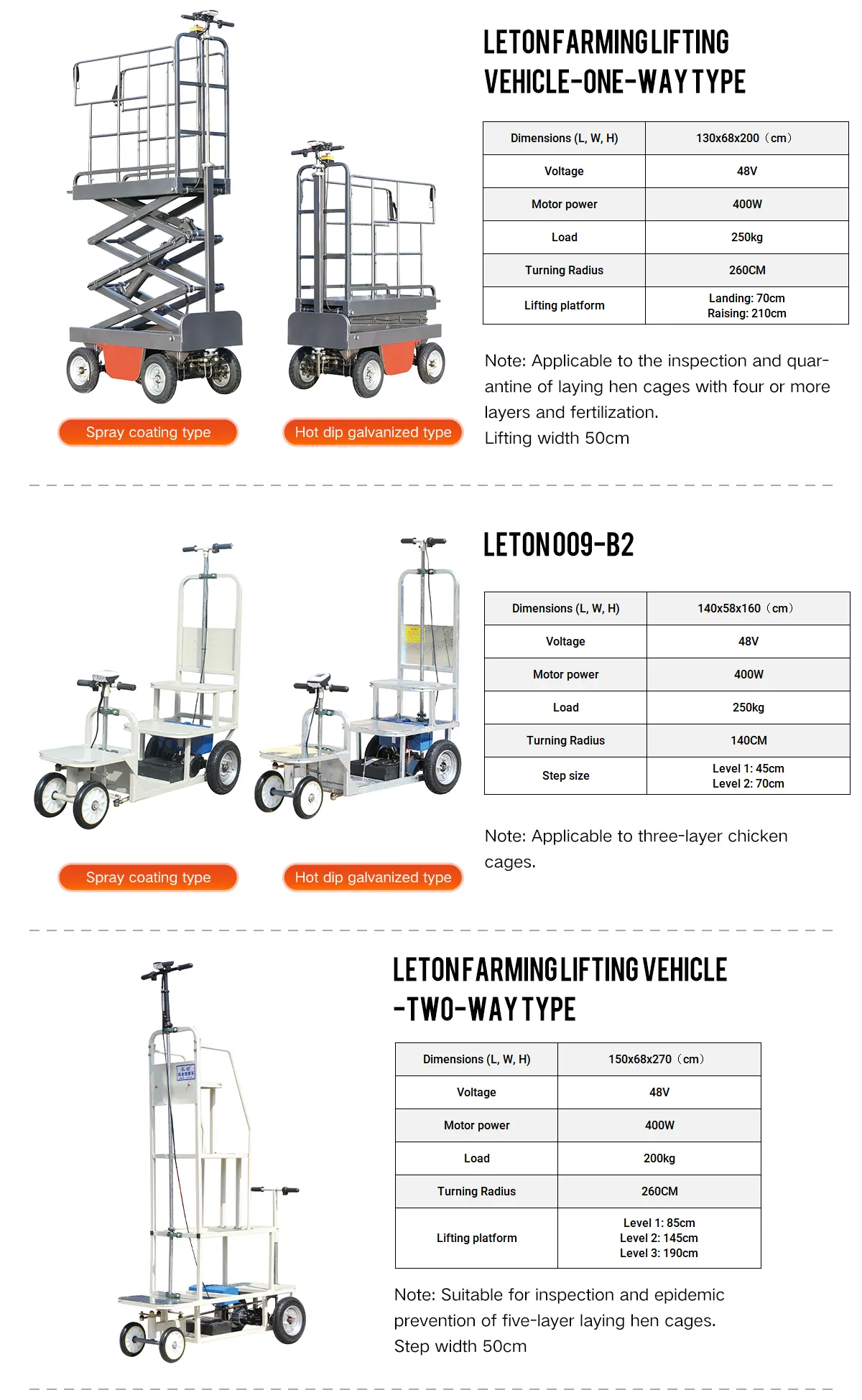
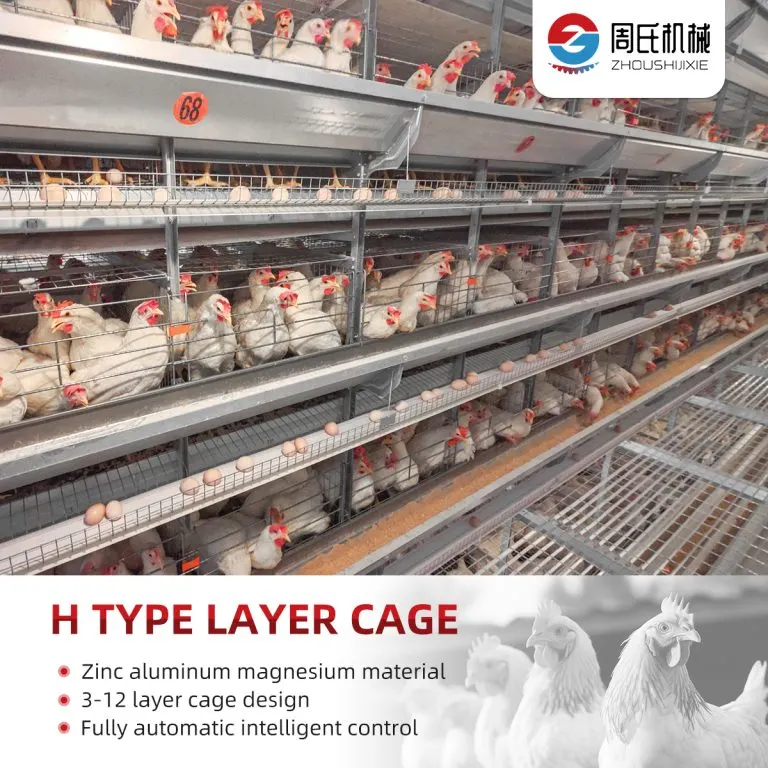
The value of an inspection car is not comfort — it is mortality detection. A worker on a 48 V ride-through patrol checks every tier every round; a worker on foot checks the first 30 meters and guesses the rest. Our two-way rail vehicle runs 48 V / 400 W with a 250 kg payload carrying an operator, spare parts and a mortality trolley down the central aisle at the height of the bird rows — production capacity 5,000 units/year, and the standard companion to our H-type 8-tier houses.
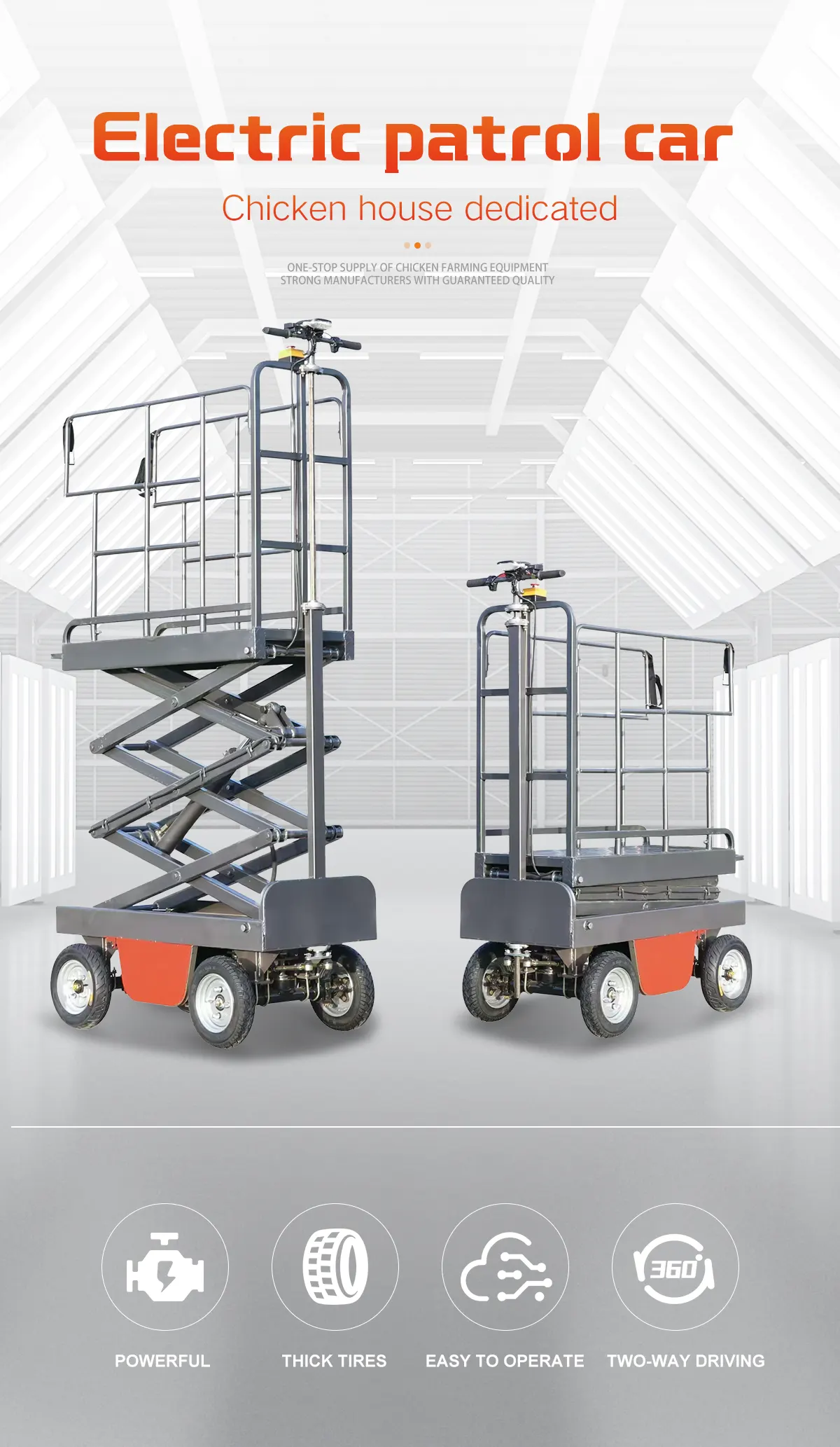
A ladder-lift variant serves cascade and aviary geometry: a lifting observation platform raises the operator to upper-tier eye level for bird-condition and egg-belt checks that ladders make unsafe and daily-round discipline makes fictional.
Key Features
Two-way rail running
The dual-direction car runs the aisle forwards and backwards without turning — battery-swapped shifts mean the round happens every round, through the night shift in peak heat.
250 kg working payload
Operator + tools + mortality cart + replacement parts: the car makes the repair happen on the pass, not in a second trip to the shed.
Ladder-lift observation platform
Upper-tier access with guardrails for belt, nipple and bird inspection at height — the variant welfare and integrator audit houses specify.
Low voltage in a wet building
48 V electrics in a washed, corrosive house is a safety decision as much as a battery one — same voltage philosophy as our in-tier lighting.
When This Pays for Itself
On an 8-row H-type house, foot inspection of every tier is a two-person half-day; with the patrol car it is one person per round, hourly if program demands. That converts "we check daily" into "we check hourly," and detection speed on dead, stuck or off-water birds is exactly what caps a mortality week. Auditors and integrator QA programs increasingly write row-inspection frequency into the contract — the car makes the clause affordable.
Supply
Rail profiles, drive car, charger and safety stops ship in the container with your cage order (freight-logical alongside tier framing), or standalone by sea on request; MOQ 1 unit. Site rail-leveling guidance comes with the drawings — critical, because a patrol car that climbs its own track is a leveling job done at the wrong stage. The same 48 V family powers our tier lighting, so spares and charger pools stay common.
| Chicken House Inspection Car — Specifications |
|---|
| Voltage / drive | 48 V · 400 W |
| Payload | 250 kg |
| Variants | Two-way riding car · ladder-lift observation vehicle |
| Rail | Galvanized guide rail, two-way running |
| Safety | End stops, guardrails (lift variant) |
| Production | 5,000 units/year |
| Voltage philosophy | 48 V family (shared with tier LED system) |
| Integration | H-type houses, aviary/cascade houses |
| MOQ | 1 unit |
| Shipping | Flat-pack, container-optimized |
Shipping, Payment and After-Sales
We export to customers across Africa, Asia and the Middle East — including Nigeria, Tanzania, Ghana, Uganda, Kenya, Zambia, South Africa, Mozambique, Senegal, Cameroon, Zimbabwe, Malawi, the Philippines, Guyana, Gambia and Equatorial Guinea. Full container loads ship as bulk-packed sets; LCL orders travel in wooden cases.
| Payment terms | 30% deposit, 70% balance before loading — T/T, PayPal, Western Union, MoneyGram |
| Lead time | About 600 sets in stock; 5 days to ship from stock, ~20 days after production; full order preparation in ~2 weeks |
| Container loading (typical layer cages) | 20GP: 130 sets (3-tier) / 100 sets (4-tier) · 40GP: 280 / 210 · 40HC: 300 / 225 |
| Sea transit (reference) | Lagos ~45 d · Mombasa 25–43 d · Tema ~50 d · Cebu/Manila 12–14 d · Durban ~30 d · Maputo ~36 d · Dar es Salaam ~38 d |
| After-sales | Installation drawings and videos free of charge, online guidance, engineer dispatch available, lifelong poultry-farming consultant support |
Why Buyers Choose ZEUSYANG
- Own factory, 15+ years — hot-dip galvanizing, roll-forming and welding lines under one roof in Cangzhou, Hebei. Video factory tours available on request.
- One-stop supply — cages plus feeding, drinking, egg collection, manure removal, ventilation, cooling and environmental control from a single quotation.
- Engineered for longevity — 275 g/m² hot-dip galvanized surfaces rated 15–20 years in house; stainless and aluminum wear parts where corrosion is worst.
- Layout before quotation — send flock size and house dimensions, our engineers return cage layout drawings, equipment lists and FOB prices.
- Delivery you can plan around — about 600 sets in stock, 2 weeks to prepare a full order, 5 days to ship from stock or 20 days after production.
- Installation that works at destination — free drawings and installation videos, online guidance, and engineer dispatch to your farm when needed.