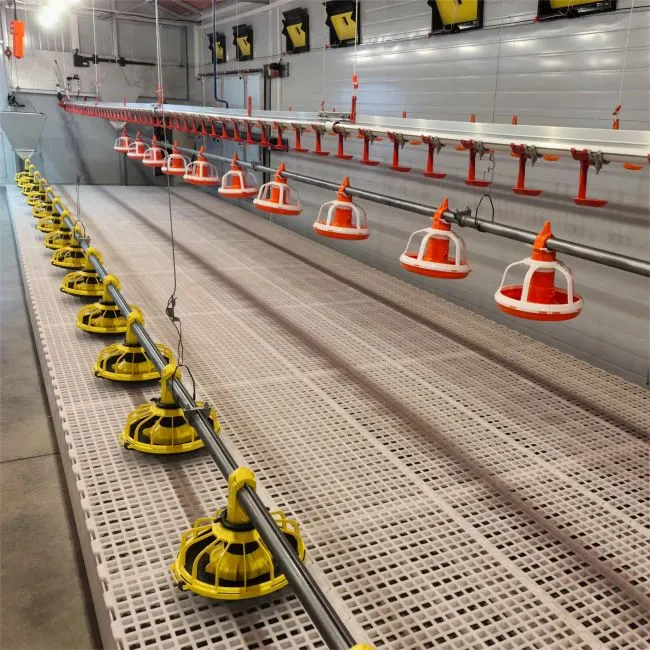
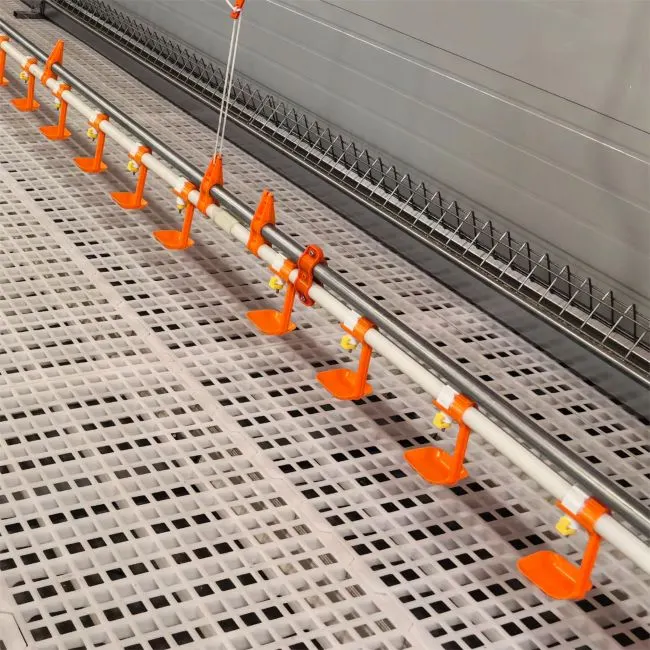
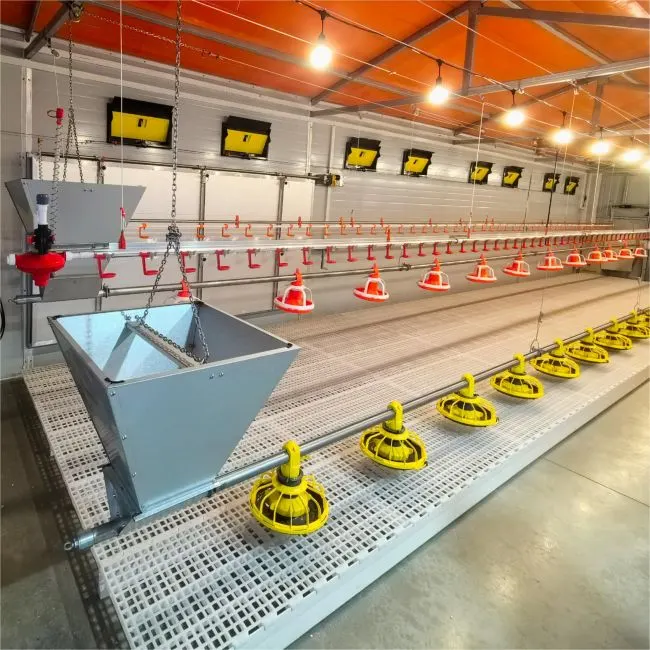
Not every farm should cage — free-range brands, halal live-bird markets, and low-capital startups all need the floor house. What they should not keep is the labor: nine daily feed runs, dragged drinkers, and wet litter patched by hand. Our floor rearing system automates a deep-litter house with a feeding line built on Φ45 mm hot-dip galvanized pipes (1.2 mm wall, 275 g/m² zinc) driving spring-coupled augers into PP feed pans, with German IFM level sensors calling each pan, on 22 mm PVC square drinking lines with nipples and drip cups.
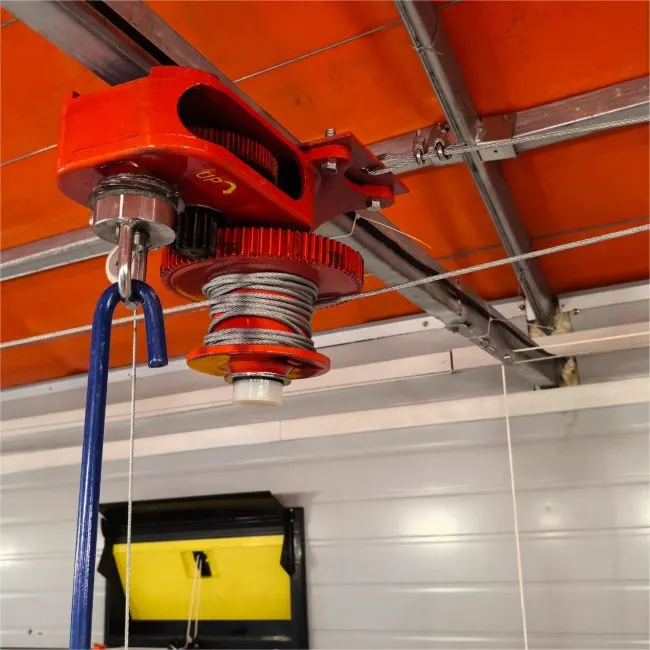
The line raises with the birds — manual crank or electric winch — so pans and drinkers track from chick height to mature height without tools. Stocking runs 10–12 birds/m² within a production capacity of 1,000 floor systems per day from our plant.
Key Features
Pan feeding with real electronics
Spiral spring augers transfer feed pan to pan with IFM level sensors reading fill state — the line tops up pans that are eaten down and stops those that are not, cutting feed waste that reads as "normal" on manual lines.
Raise the line, not the labor
Manual or electric hoists lift the complete feed and water lines as birds grow — one operator, minutes, no ladders and no back strain, weekly through the cycle.
Dry litter engineering
Nipple lines with drip cups on a PVC 22 mm square profile keep water out of the litter; dry litter is the difference between healthy feet and a condemnation report.
8–10 year rated kit
Galvanized pipe lines, UV-stabilized PVC and PP pans with a service life of 8–10 years in normal houses — and every spare auger section, pan and nipple stocks from one catalog.
Why Automation Without Cages Still Pays
A floor house costs a fraction of a cage house to build. Left manual, it costs a farm its margins in labor hours, feed waste and wet-litter losses. Pan feeding with sensor control typically trims feed spillage to near zero because a pan is only topped when empty — the manual "keep them full" habit that buries feed in litter simply cannot happen on an instrumented line. Add nipple drinking with cup catchment and litter stays workable longer between thinnings, which is worth live-bird weight at market week.
Spec & Support
Tell us house length and bird count; we specify line lengths, pan counts per line, pressure-regulated water sets, hopper take-off from your feed silo or bin, and the raising winch (manual or electric). Lines ship flat-packed with drawings and installation videos; online guidance and on-site engineer support are available the same as for our cage systems, and the whole family shares spare parts with our cage feeding lines — one container, one supplier, one spares shelf.
| Floor Rearing System — Specifications |
|---|
| Feed pipe | Φ45 mm, 1.2 mm wall, hot-dip galv. 275 g/m² |
| Feeders | PP pans, spiral spring auger transfer |
| Level sensing | German IFM sensors per pan group |
| Water | 22 mm PVC square line, nipples + drip cups |
| Raising | Manual crank or electric winch |
| Density | 10–12 birds/m² |
| Service life | 8–10 years |
| Production | 1,000 sets/day |
| MOQ | 50 sets |
| Warranty | Written terms in proforma |
Shipping, Payment and After-Sales
We export to customers across Africa, Asia and the Middle East — including Nigeria, Tanzania, Ghana, Uganda, Kenya, Zambia, South Africa, Mozambique, Senegal, Cameroon, Zimbabwe, Malawi, the Philippines, Guyana, Gambia and Equatorial Guinea. Full container loads ship as bulk-packed sets; LCL orders travel in wooden cases.
| Payment terms | 30% deposit, 70% balance before loading — T/T, PayPal, Western Union, MoneyGram |
| Lead time | About 600 sets in stock; 5 days to ship from stock, ~20 days after production; full order preparation in ~2 weeks |
| Container loading (typical layer cages) | 20GP: 130 sets (3-tier) / 100 sets (4-tier) · 40GP: 280 / 210 · 40HC: 300 / 225 |
| Sea transit (reference) | Lagos ~45 d · Mombasa 25–43 d · Tema ~50 d · Cebu/Manila 12–14 d · Durban ~30 d · Maputo ~36 d · Dar es Salaam ~38 d |
| After-sales | Installation drawings and videos free of charge, online guidance, engineer dispatch available, lifelong poultry-farming consultant support |
Why Buyers Choose ZEUSYANG
- Own factory, 15+ years — hot-dip galvanizing, roll-forming and welding lines under one roof in Cangzhou, Hebei. Video factory tours available on request.
- One-stop supply — cages plus feeding, drinking, egg collection, manure removal, ventilation, cooling and environmental control from a single quotation.
- Engineered for longevity — 275 g/m² hot-dip galvanized surfaces rated 15–20 years in house; stainless and aluminum wear parts where corrosion is worst.
- Layout before quotation — send flock size and house dimensions, our engineers return cage layout drawings, equipment lists and FOB prices.
- Delivery you can plan around — about 600 sets in stock, 2 weeks to prepare a full order, 5 days to ship from stock or 20 days after production.
- Installation that works at destination — free drawings and installation videos, online guidance, and engineer dispatch to your farm when needed.